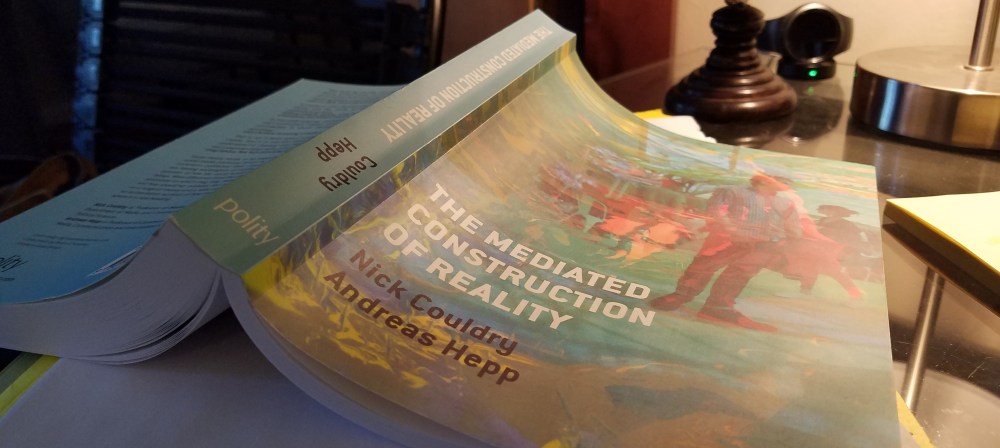
 This week’s post is a little bit different. As I mentioned, I’m a graduate student. For those who don’t know, that means an insane amount of reading. Between two classes I’m assigned an average of 8-10 peer reviewed journal articles per week, plus outside reading to prepare for research papers. Add to that the fact that shooting terrorists in Rainbow Six: Siege is also a lot of fun, and you can see how “fun” reading can quickly take a back seat. But since I have to write about these readings anyway, I might as well share them right? They’re still books, and I still drink beer while reading them.
This week I’m reading The Mediated Construction of Reality by Nick Couldry and Andreas Hepp. It’s a densely academic book about the nature of reality and how media has become so ingrained in literally everything we do that it now shapes our notion of what reality is. I’m reading it to prepare for a paper on social media use in politics.
Though this is a bit of a slog to get through, it actually starts to make a lot of sense the further into it you get. Basically, there’s two overall schools of thought about reality: it’s either objective and we simply exist within it (otherwise known as positivism), or reality is constructed by the individual and/or society (otherwise known as social constructivism).
In a way that you’re probably more familiar with: If a tree falls in the forest and there’s no one there to hear it, does it make a sound? The positivist says yes, the social constructivist says no, Couldry and Hepp say “if it was caught on film”.
The Mediated Construction of Reality begins with the same basic principle as Berger and Luckmann’s famous social construction of reality: reality is given meaning by the people who inhabit it, their relationships to one another, and the power structures they create. Broadly, this defines “society” or “the social”, and therefore reality is said to be “socially constructed”. As Couldry and Hepp point out however, Berger and Luckmann say “almost nothing about technologically based communication” (p.6), a key issue that became increasingly important in the second half of the twentieth century with the diffusion of mass media..
The mediated construction of reality can be summarized as follows: Reality is socially constructed. Communication is necessary to expand social reality beyond the individual. Media is needed to further expand reality beyond the immediate here and now, and thus has become necessary for communication. Therefore, media is an essential component for the construction of reality.
Couldry and Hepp’s main argument is that any theory of the social world that does not incorporate media, or that prioritizes face-to-face communication is incomplete (p. 33). They further argue that media is so ingrained in society that even face-to-face communication rarely does not reference media. Thus, the idea of mediatization: the bi-directional process by which society and communication are changed by media, and media is changed by society and communication. Ultimately this leads to “deep mediatization” in which all social processes are reliant upon mediated communication (p. 39 ).
Mediatization has occurred in “waves” over the last 600 years, with each wave tied to the invention of critical technologies. Each wave results in changes to society, which result from the increased access to information. This can be traced from mechanization (the printing press/moveable type), to electrification (telegraph, telephone, film, etc), to digitalization (the Internet), to the now emerging wave of datafication (p. 35). With each new wave of mediatization, social institutions are less constrained by space and time, allowing for the expansion of social reality.
Couldry and Hepp also argue that because of mediatization, reality is now being shaped by “figurations” (essentially a “whole is greater than the sum of its parts” approach to networks) rather than by individuals. Figurations are defined by three elements: First, “relevance frames” tie the figuration together by a common purpose or element (i.e. a family, social movement, or political party). Second, figurations are made up of people (though they are mediated by technology and objects, the human element is the most important). Finally, figurations are built upon certain shared practices, which can depend upon technology and objects, and is susceptible to mediatization.
It is this final point that makes the mediated construction of reality important in the context of social movements. Movements are figurations, which can be mediatized, meaning they can be both changed by mediated communication practices and in turn change media. An excellent example of this is in the sphere of United States political debate. Though political parties and political movements as figurations have been around since the country’s founding, in the last 25 years they have been radically altered due to the advent, and then prevalence, of social media. Social media has had multiple effects on the political process, many of which can be understood through the lens of a mediated construction of reality.
And here’s where I trail off into the next paragraph of the paper, which (theoretically) will be discussing ways in which social media has affected the political process, from the perspective of a mediated construction of reality.
Fun!

 Books, Beer, and the Future